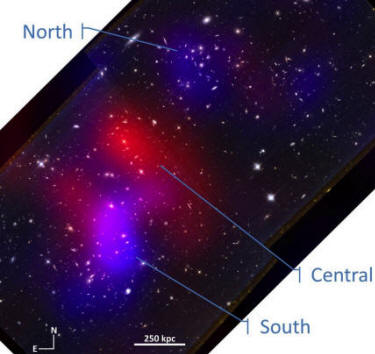
Constraining Self-Interacting Dark Matter with Cluster Mergers
The Musket Ball Cluster (see below) led me to appreciate
the importance of galaxy cluster mergers as laboratories for
finding self-interacting dark matter. We know remarkably
little about dark matter: it could interact with itself at
the level of the strong nuclear force and we wouldn't know
it yet. Merging clusters are basically dark matter
colliders---something we can't build on Earth---which will
tell us the self-interaction cross section. Here's the
basic story of a cluster merger in the standard case of no
self-interaction: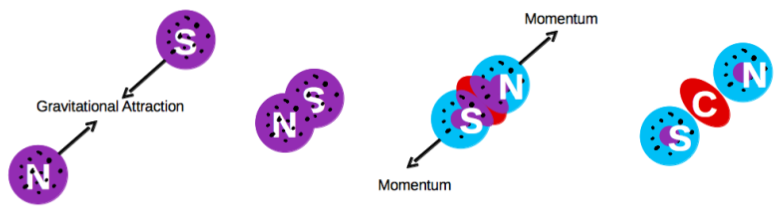
where the dots represent galaxies, blue represents the dark matter,
and red represents gas (purple is a mixture of blue and red). Not all
mergers occur have the right conditions to make the dissociation
between gas and dark matter so clear, but some do. Now here's the story with
self-interacting dark matter:
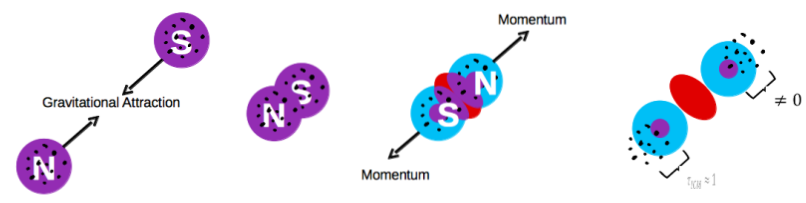
The self-interaction of the dark matter manifests itself as a slight
lag of the dark matter behind the galaxies. My group is vigorously
pursuing observations of an ensemble of mergers to detect (or place an
upper limit on) any galaxy/dark matter separation. See
the Merging
Cluster Collaboration for more details and some nice pictures.